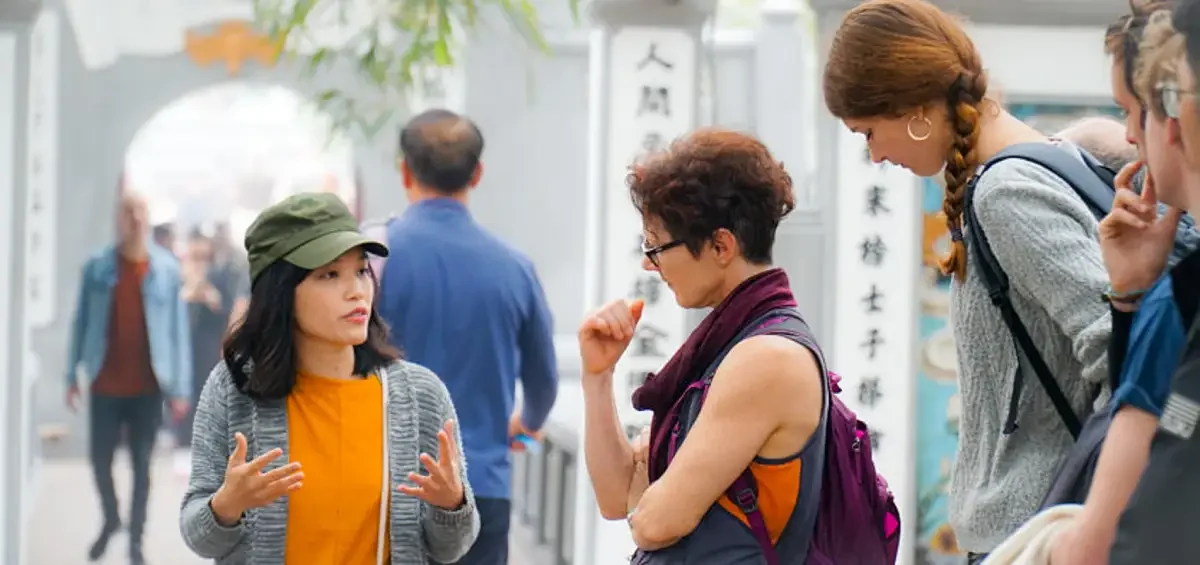
Hanoi Walks · Vietnam · July 2026
The Complete Hanoi French Quarter Guide: Colonial Streets, History & How to Explore
The Hanoi French Quarter feels like a different city from the Old Quarter — and in a sense, it is. Wide tree-lined boulevards replace guild-street maze. Ochre villas and shuttered balconies replace tube-house density. Cyclos are rare; black sedans and diplomatic plates appear outside ministry gates.
This district is where French Indochina projected administrative power from the late 19th century through mid-20th century — and where independent Vietnam later reclaimed those same streets for its own institutions. Walking here is not nostalgia tourism. It is reading layers: colonial ambition, wartime rupture, reunification symbolism, and the café culture Hanoians adopted and made their own.
Our French Quarter place guide maps the geography. This pillar article goes deeper on history, landmarks, practical routing, and how to connect the French Quarter to the Old Quarter and Ba Dinh political district. For a guided route with local interpretation, see the Hanoi French Quarter Tour.
A Brief History: From Colonial Capital to Modern Hanoi
France consolidated control over northern Vietnam in the 1880s and developed Hanoi as the capital of Indochina. Urban planners imposed a European grid south and west of the existing Vietnamese city — the "36 streets" Old Quarter remained the commercial heart, while the new quarter housed government, banks, villas, and the cathedral.
Colonial architecture favoured neoclassical and Beaux-Arts forms adapted to tropical climate: high ceilings, wide verandas, yellow limewash that still defines the streetscape. Key institutions — the Governor's Palace (now Presidential Palace), the Opera House, the State Bank — anchored prestige corners.
Independence in 1954 and reunification in 1975 repurposed many buildings rather than erasing them. The French Quarter today is a working government and embassy zone, not a themed heritage park. Security presence is normal near official sites. Photography restrictions apply at some gates — observe signage.
Understanding this timeline prevents a common mistake: treating the French Quarter as "the pretty part" separate from Vietnamese history. Vietnamese history happened here — prisons, protests, diplomatic recognition, everyday life in flats carved from former servants' quarters.
Boundaries: Where the French Quarter Begins
Geography is debated even among locals, but a practical visitor boundary works like this:
**East:** The Old Quarter edge near St. Joseph's Cathedral and Nha Tho Street — brick church as transition marker.
**South:** Trang Tien Street along the south shore of Hoan Kiem Lake — bookshops, ice cream, weekend pedestrian flow.
**West and north:** Phan Dinh Phung, Hoang Dieu, and the Ba Dinh institutional cluster toward the Ho Chi Minh Mausoleum.
The history topic hub links articles across these districts. If you are plotting a multi-day plan, our 2 days in Hanoi itinerary separates Old Quarter and French Quarter days deliberately — each deserves focused time.
Key Landmarks Worth Visiting
Hanoi Opera House
Completed in 1911, modelled after Paris's Palais Garnier at reduced scale. Exterior colonnades and evening lighting draw photographers; performances still run — check schedules for opera, ballet, or cultural shows rather than assuming daily tours. The square in front hosts political gatherings on national dates.
St. Joseph's Cathedral
Neo-Gothic brick cathedral consecrated in 1886. Weekend masses and wedding photography crowds fill Nha Tho Square. Respect active worship — visit outside service times for casual photography, dress modestly if entering. The surrounding cafés (including egg coffee spots) are a social scene unto themselves; see coffee culture.
Hoa Lo Prison (Hanoi Hilton)
A colonial prison later used during the American War. Exhibits focus on Vietnamese resistance narratives; the name "Hanoi Hilton" references American POW detention in a section now demolished. Allow 60–90 minutes; emotionally heavy. Our Hoa Lo place guide covers ticketing and tone expectations.
Presidential Palace & Ba Dinh Square
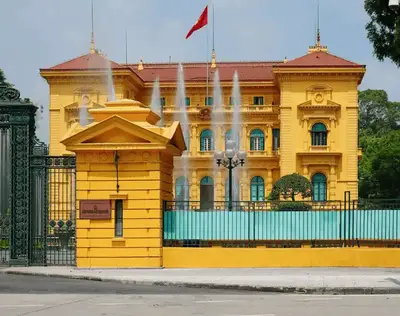
The yellow palace remains a working government site — exterior viewing from gates and gardens, not casual entry. Nearby Ba Dinh Square is where Ho Chi Minh read the Declaration of Independence in 1945. The mausoleum operates strict hours, dress codes, and bag checks.
State Bank of Vietnam & Ministry Buildings
Architectural highlights along Ly Thai To and Dien Bien Phu — our guides use these façades to explain economic history on the French Quarter tour. You will recognise the State Bank from guest photos in our private tours article.
Trang Tien Plaza & Book Street
Commercial counterpoint to ministry solemnity — modern retail in a historic shell, plus weekend reading culture along pedestrian book stalls near the lake.
Walking Routes That Make Sense
**Classic history loop (3 hours):** Hoan Kiem south shore → Trang Tien → Opera House exterior → Ly Thai To ministries → Hoa Lo Prison → cathedral square coffee stop → optional extension toward Ba Dinh if energy allows.
**Architecture & café (2.5 hours):** Cathedral square morning → side streets behind Dien Bien Phu → tree-lined Phan Dinh Phung (often cited as Hanoi's most beautiful street) → return via lake.
**Ba Dinh extension (add 2 hours):** Link French Quarter walk to Presidential Palace exterior → mausoleum square → Temple of Literature via our city tour geography.
Avoid midday summer walks on unshaded boulevards — heat on asphalt is brutal between 11 a.m. and 3 p.m. Morning or late afternoon matches how our guides schedule the French Quarter tour.
Hanoi History & French Quarter Walking Tour
Colonial history, not Old Quarter markets
This is Hanoi's French Quarter and history walk — focused on colonial boulevards, political landmarks, and the stories of war and independence that shaped modern Vietnam. If you want the 36 streets, local markets, and alleyway life of the Old Quarter, choose our separate Old Quarter Walking Tour instead. On this experience, you step into a quieter, more elegant side of Hanoi, where French colonial architecture meets Vietnamese identity. As you walk through tree-lined boulevards and historic buildings, you uncover stories of colonization, resistance, war, and transformation that still define the city today. This is not about seeing landmarks. It is about understanding what happened here — and why it still matters.
French Quarter vs Old Quarter: Which First?
Travelers often ask which district to prioritise. They serve different questions.
The Old Quarter answers: How do ordinary Hanoians shop, eat, and commute in historic density?
The French Quarter answers: How did colonial power reshape urban space, and how did independent Vietnam inherit that infrastructure?
If you have one day, choose based on interest — food and market life lean Old Quarter; political and architectural history lean French Quarter. If you have two days, do both without blending them into a rushed hybrid. Our best walking tour comparison breaks down six tour types by focus.
Coffee, Dining & Evening Life
The French Quarter is not a street-food primary zone like the Old Quarter — though baguettes and bánh mì appear on corners. Expect sit-down cafés, hotel restaurants, and international price points near Trang Tien.
Egg coffee originated in Hanoi — several famous cafés sit near the cathedral. Order *cà phê trứng*; expect sweet, rich foam unlike Italian cappuccino.
Evening life is calmer than Ta Hien beer street in the Old Quarter. Diplomatic security and residential norms keep noise lower. Sunset photography at the lake south shore pairs well with a French Quarter afternoon.
Practical Information
**Dress code:** Modest clothing for mausoleum and temple visits — covered shoulders and knees, no hats inside mausoleum queue.
**Security:** Do not photograph military guards at restricted gates. Follow staff instructions at government sites.
**Tickets:** Hoa Lo Prison and mausoleum (when open) require tickets; Opera House entry is performance-dependent.
**Transport:** Grab works well; walking between lake and cathedral is compact. Ba Dinh adds distance — taxi or guided walk.
**Language:** Signage is Vietnamese with increasing English at major sites. A guide accelerates context at ministries and prison exhibits.
Our travel tips hub covers visas, SIM cards, and seasonal weather affecting outdoor history walks.
Photography Tips
Golden hour on Phan Dinh Phung — long shadows under flame trees. Opera House front elevation best from across the square. Cathedral: wide angle from Nha Tho Square; interior dim — higher ISO. Mausoleum: strict rules — no photos inside the viewing hall.
For photography as a primary interest, see the photography topic and hidden gems for less obvious frames beyond colonial postcards.
Guided Tours: When History Needs Context
Facades alone rarely convey why a yellow palace matters, or how Hoa Lo's narrative differs from Western POW memoirs. Our French Quarter walking tour is built for that gap — colonial urban planning, independence milestones, and the Vietnamese stories inside buildings tourists photograph without understanding.
The tour is private, not a megaphone group. Pace adjusts for heat, photography stops, and depth questions. Same guide standards as our Travelers' Choice–recognised team — details in private tours article.
Hanoi History & French Quarter Walking Tour
Colonial history, not Old Quarter markets
This is Hanoi's French Quarter and history walk — focused on colonial boulevards, political landmarks, and the stories of war and independence that shaped modern Vietnam. If you want the 36 streets, local markets, and alleyway life of the Old Quarter, choose our separate Old Quarter Walking Tour instead. On this experience, you step into a quieter, more elegant side of Hanoi, where French colonial architecture meets Vietnamese identity. As you walk through tree-lined boulevards and historic buildings, you uncover stories of colonization, resistance, war, and transformation that still define the city today. This is not about seeing landmarks. It is about understanding what happened here — and why it still matters.
For broader city coverage linking West Lake and Ba Dinh, the Hanoi City Tour complements but does not replace French Quarter focus — different geography, different narrative emphasis.
Connecting to Nearby Places
**Hoan Kiem Lake:** Southern shore is French Quarter gateway — read our lake guide.
**Old Quarter:** East of cathedral — shift from boulevards to guild streets in ten minutes on foot.
**West Lake:** Larger scale lakeside life — pagodas, residential expat history, different from central Hoan Kiem.
**Train Street:** Not in the French Quarter — do not conflate; access via Old Quarter alleys on dedicated tour.
Colonial Architecture: Reading the Façades
French Quarter buildings reward slow looking. Key details:
**Limewash yellow** — not mere aesthetic; tropical lime plaster breathes better than sealed modern paint. Repainting cycles keep the district visually coherent.
**Green shutters** — functional sun control before air conditioning; note which floors still open shutters daily versus sealed office glazing.
**Iron balconies** — imported or locally forged patterns; compare Opera House opulence to residential simplicity on side streets.
**Tree canopy** — deliberate planting along Phan Dinh Phung and Hoang Dieu; maturity achieved only after decades — reason these streets feel "European" in humidity.
**Adaptive reuse** — embassies in villas, schools in former clinics, apartments in staff quarters. Ask your guide on the French Quarter tour which buildings remain government-only versus publicly accessible lobbies.
Museums & Deeper History Stops
Beyond Hoa Lo, consider:
**Vietnam National Museum of History** (Trang Tien area) — chronological exhibits from prehistory through revolution; air-conditioned half-day.
**Vietnam Museum of Revolution** — Ba Dinh proximity; overlaps politically with mausoleum visit.
**Fine Arts Museum** — Vietnamese modern art in colonial villa setting; quieter alternative to crowded temples.
Our museums topic indexes these alongside smaller houses. None replace walking the boulevards — they supplement narrative you begin on pavement.
French Quarter for Families & Seniors
Wider pavements and fewer motorbike conflicts than Old Quarter lanes — but summer heat on unshaded stretches challenges elders and children.
**Strategy:** Taxi between Ba Dinh clusters, walk shaded Phan Dinh Phung, café rest every 45 minutes, cathedral square as natural pause. Mausoleum queues offer no seating — assess stamina honestly.
Strollers fit main boulevards; cobble side paths near lake do not. Private tours adjust speed — another reason families book French Quarter and city walks over independent midday marathons.
Evening & Night Atmosphere
French Quarter nights lack Old Quarter beer chaos — diplomatic residences, dimmer lighting, couples strolling Trang Tien after ice cream. Security presence near government gates remains visible.
**Photography:** Opera House illumination after dark; long exposure for car light trails on Dinh Tien Hoang where weekend pedestrian zones begin.
**Dining:** Hotel restaurants and upscale Vietnamese-French fusion dominate — not plastic-stool territory. For bún chả after history day, walk east into Old Quarter ten minutes.
Our night walking tour starts at lake but emphasises Old Quarter energy — complementary, not duplicate of French Quarter afternoon.
Sample Half-Day French Quarter Itinerary
**8:00 a.m.** — Lake south shore coffee and book street browse.
**9:00 a.m.** — Opera House exterior and square history stop.
**10:00 a.m.** — Walk Ly Thai To past State Bank; guide or audio context on economic history.
**11:00 a.m.** — Hoa Lo Prison visit (90 minutes interior).
**1:00 p.m.** — Lunch near cathedral square; egg coffee dessert.
**2:30 p.m.** — St. Joseph's interior if open; wedding photo crowds peak Saturdays.
**4:00 p.m.** — Phan Dinh Phung shaded walk toward Ba Dinh exterior gates.
Stop here unless mausoleum interior is a personal priority — that adds queue time unpredictable without morning arrival.
French Quarter Hotels, Embassies & Quiet Corners
Embassy row along Dien Bien Phu and Hoang Dieu imposes subtle security culture — ID checks rare for pedestrians but photography of guard posts discouraged. Hotels in this zone cater to business and diplomatic travel — higher price, calmer sleep than Ta Hien backpacker density.
**Sofitel Legend Metropole** and heritage properties near Opera House offer afternoon tea as cultural experience — colonial nostalgia priced accordingly, not mandatory for budget travelers.
**Cong Ly and side alleys** behind ministries reveal vegetable vendors serving government office workers — photogenic local life without Old Quarter motorbike chaos if you know which ngõ entries are public.
**Phan Dinh Phung flame trees** bloom roughly April–May — exact weeks vary by weather; photographers plan return visits when first petals drop.
Reading Independence History on the Pavement
French Quarter walks should connect physical space to 1945 Declaration of Independence at Ba Dinh, 1954 Geneva partition aftermath, and 1975 reunification narratives taught in Vietnamese schools. Buildings are not neutral scenery — they are arguments in stone about who governs and how.
Our history topic links articles on Hoa Lo, mausoleum, and colonial urban planning. Without that frame, Opera House is just a pretty wedding backdrop.
Money, Tickets & Budget Planning
Hoa Lo Prison entry fee modest — budget 90 minutes plus ticket queue. Mausoleum free for viewing hall but strict hours — no wasted taxi if closed Monday/Friday. Opera House performances vary €5–40 equivalent depending on seat — book official box office, not sidewalk scalpers.
**ATM locations** along Trang Tien and Dinh Tien Hoang — international cards usually work; notify bank before travel.
**Grab** from Old Quarter to Opera House cheap — walking also viable if heat manageable.
**Combined day cost** (self-guided): coffee €2, prison ticket €3–5, lunch €5–10, optional opera evening separate — far less than organised coach tours charging bundle markup for same pavement.
French Quarter vs Ba Dinh: Administrative Geography
Travelers merge districts mentally — separate them for planning.
**French Quarter** — colonial commercial and cultural institutions, cathedral, opera, south lake shore.
**Ba Dinh** — independence-era political monuments, mausoleum, assembly house, presidential palace gates.
Overlap exists geographically — narrative distinction prevents checklist fatigue. Our city tour bridges West Lake to Ba Dinh to Temple of Literature; French Quarter tour stays colonial-lake axis without West Lake geography.
Solo Female & LGBTQ+ Traveler Notes
Hanoi French Quarter feels comparatively open — solo women walk boulevards daytime without unusual harassment beyond global city norms. Night near lake remains active; trust instincts in empty side streets. LGBTQ+ travelers generally find urban Vietnam tolerant in public spaces though conservative household norms persist — our guides treat all guests professionally; no special routing required for safety, only standard urban awareness.
Opera House & Performance Booking Tips
Check **Hanoi Opera House** website and box office for ballet, ao dai fashion shows, and traditional music — booking direct avoids tour agency markup. Dress smart-casual for performances; photos prohibited during shows. Even without tickets, evening exterior lighting rewards walkers looping lake south to opera square.
Final Thoughts
The French Quarter rewards travelers who read buildings as documents — not Instagram backdrops alone. Walk slowly enough to notice shutter hardware, ministry flags, schoolchildren cutting through palace lanes on bicycles.
Pair this district with the Old Quarter for contrast: maze versus grid, stool dining versus café sitting, guild heritage versus colonial administration. Together they explain central Hanoi better than either alone.
If history is why you came to Vietnam, spend a full morning here before rushing to Ha Long Bay. The city’s political soul lives in these streets — still active, still evolving, still asking visitors to look up from the pavement.
About this guide
- Experience
- Hanoi Walks French Quarter tours are led by guides including urban-planning graduates and historians who walk these boulevards weekly — not only when booked. We meet guests at lake landmarks, time routes to avoid mausoleum closure surprises, and use the same coffee stops we recommend in this guide. Shaw, Emma, and Manuel's Tripadvisor reviews (cited on our tour page) specifically mention French Quarter depth — Opera House context, cathedral surroundings, non-touristy side streets. We update routing when security cordons affect Ba Dinh access, as happened during recent state events in 2025–2026.
- Expertise
- Editorial content draws on Vietnamese and French colonial historiography, municipal heritage inventories, and site-specific museum materials at Hoa Lo. We distinguish accurately between remaining prison structures and demolished wings referenced in POW literature — a common visitor confusion our guides address. Architectural descriptions align with documented completion dates (Opera House 1911, cathedral 1886). We do not reproduce nationalist or colonial clichés; we explain how contemporary Vietnamese institutions occupy inherited buildings.
- Authority
- Hanoi Walks operates the dedicated Hanoi French Quarter Tour with published itineraries, meeting points, and hundreds of verified guest reviews on Tripadvisor through our associated Free Walking Tours Hanoi entity (Travelers' Choice 2026). Our French Quarter place hub, history topic pages, and this pillar article interlink with the same tour product — consistent geography, no contradictory advice. Guides hold licenses required for tourism operation in Vietnam and conduct tours in English with Vietnamese source access for signage and exhibit detail.
- Trust
- Tour recommendations are transparent — this guide links to our French Quarter and city tours but provides independent walking routes and public-site information usable without booking. We do not inflate historical claims for marketing; dates and building uses are verified. No sponsored café or hotel placements appear in our editorial copy. Pricing and meeting details for linked tours match hanoiwalks.com at publication. WhatsApp support answers access questions (mausoleum hours, prison tickets) with current field checks rather than outdated blog reposts.
Frequently asked questions
What is the Hanoi French Quarter known for?
Colonial-era boulevards, ochre villas, the Hanoi Opera House, St. Joseph's Cathedral, Hoa Lo Prison, and the government institutions around Ba Dinh — including the Presidential Palace and Ho Chi Minh Mausoleum. It is the administrative and diplomatic heart of capital Hanoi, distinct from the commercial Old Quarter.
How long does it take to walk the French Quarter?
A focused history walk from Hoan Kiem Lake to Hoa Lo Prison and the cathedral takes roughly three hours on foot. Adding Ba Dinh Square and the mausoleum exterior extends this to five hours. Spread across morning and late afternoon if visiting in summer heat.
Is the French Quarter worth visiting if I prefer street food?
Yes, but prioritise the Old Quarter for food depth — see our street food guide. The French Quarter offers cathedral-square egg coffee, boulevard cafés, and lake-side dining rather than plastic-stool phở culture. Many travelers do a food morning in the Old Quarter and a history afternoon here.
Can I visit the Ho Chi Minh Mausoleum from the French Quarter?
Yes — Ba Dinh is a logical extension north and west. The mausoleum has strict opening hours (often closed Monday and Friday), dress codes, and security checks. Arrive early for queues. Our city tour covers this geography with a guide who tracks current access rules.
Is photography allowed at government buildings?
Exterior photography is generally tolerated on public pavements, but guards may stop filming at security-sensitive gates. No photography inside the mausoleum viewing hall. Always obey posted signs and staff directions — rules can change during official events.
How is the French Quarter tour different from the Old Quarter tour?
The French Quarter tour focuses on colonial architecture, independence history, and political landmarks — Opera House, ministries, Hoa Lo, cathedral. The Old Quarter tour covers guild streets, Dong Xuan Market, tube houses, and local market life. They are complementary, not interchangeable.
Related Places
French Quarter
Place guide to the Hanoi French Quarter — colonial boulevards, key landmarks, and how to visit on foot. For history guides and articles, see the French Quarter topic hub.
Explore placeHoa Lo Prison
Explore Hoa Lo Prison in Hanoi — French colonial prison, wartime history, and a key museum in the French Quarter.
Explore placeBa Dinh Square
Explore Ba Dinh Square in Hanoi — where independence was declared and government buildings frame the mausoleum.
Explore placeFrench Quarter
Topic hub for Hanoi French Quarter planning — colonial history, architecture guides, walking routes, and curated articles. Browse stories and connect to our place guide.
1 guide
Read topic →Related Tours
Hanoi History & French Quarter Walking Tour
Colonial history, not Old Quarter markets
This is Hanoi's French Quarter and history walk — focused on colonial boulevards, political landmarks, and the stories of war and independence that shaped modern Vietnam. If you want the 36 streets, local markets, and alleyway life of the Old Quarter, choose our separate Old Quarter Walking Tour instead. On this experience, you step into a quieter, more elegant side of Hanoi, where French colonial architecture meets Vietnamese identity. As you walk through tree-lined boulevards and historic buildings, you uncover stories of colonization, resistance, war, and transformation that still define the city today. This is not about seeing landmarks. It is about understanding what happened here — and why it still matters.
Hanoi City Tour
From West Lake to Ba Dinh Square
Discover a different side of Hanoi through its lakeside charm and political heart. This walking tour takes you from peaceful West Lake to Ba Dinh Square, combining history, culture, and modern Vietnam through meaningful landmarks and local stories. From the oldest pagoda in Hanoi to the political center of modern Vietnam, every stop reveals a different layer of the city — its spirituality, its resilience, its colonial past, and its contemporary identity. This is not just a sightseeing walk. It is a journey through the places that have shaped Vietnam's history and continue to define its future.